Monday, 11 November 2013

Multichoice launches Resource Centers in Osun State

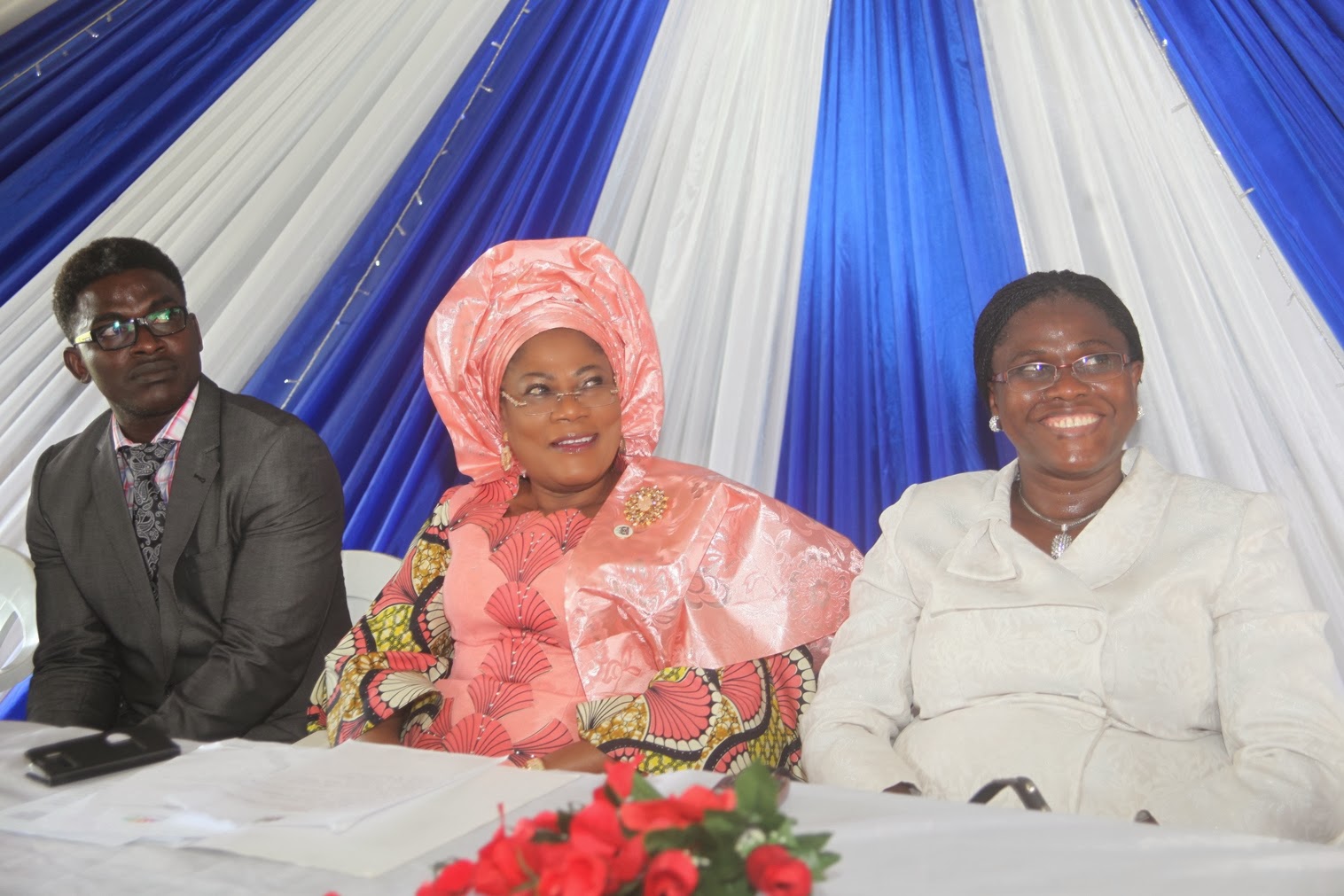
Head, Public Relations, MultiChoice Nigeria Segun Fayose, (left) 
Deputy Governor, Osun State, Titi-Laoye Tomori and CEO, Innovative Technology Literacy Services Ltd,
 Ronke Bello, during the launch of additional 10 MultiChoice Resource Centres
 in Osun State held at Ataoja School of Science, Oshogbo, Osun State recently.
                                                PHOTO BY: ADENIYI ADUNOLA


In its aim to empower teachers and students with skills in Information and Communication Technologies (ICTs), Multichoice Nigeria, the leading pay-TV firm rolled out more Multichoice Resource Centre (MRC) in public schools in Osun State.

The novel intervention has been introduced to 245 schools in 24 states of the federation and been proven to impact critically on the knowledge levels and understanding especially of technical subject areas by students. It is now being extended to students of 10 public secondary schools in Osun State, bringing the total to 255 in 25 states across the country

About 10 public secondary schools in Osun State which benefitted from the project include: Unity School, Ejigbo, Anglican Grammar School, Osogbo, ADS Grammar School, Osogbo, St. James Grammar School, Osogbo Ataoja School of Science, Baptist Grammar School, Osogbo, Laro Grammar School, Osogbo and Ijebu-jesa Grammar School, Ijebu-jesa.

Speaking at the event, the Deputy Governor, Osun State/ HCE, Ministry of Education, Grace Titi-laoye Tomori lauded MultiChoice and its implementing partner, Innovative Technology Literacy Services Limited, for the initiative which she described as a veritable tool for the provision of valuable learning resource components for public schools across the country. “The MultiChoice Resource Centre project, which provides valuable learning resource components for 10 selected public schools in the State of Osun to support the government efforts towards achieving the Millennium Development Goals (MDGs) in Nigeria’s education sector, is a welcome one,” she said.,

“This also dovetail into one of the six integral action plan of the Osun state government that aims at functional and qualitative education in the state”

MultiChoice provides the following learning aid items to each of the beneficiary schools: DSTV decoder, television set, burglary proof for the equipment, education bouquet. Others include generator, whiteboard, Uninterrupted Power Supply (UPS), among others.

The Managing Director of Innovative Technology Literacy Services Limited, Aderonke Bello said “The MultiChoice resource centre is designed to grant beneficiary schools access to the special MultiChoice Education Bouquet with the aim of integrating the programmes into their curriculum to further enhance the teaching and learning processes in the classrooms”

“in line with modern technology, our secondary schools in Osun state, are being familiarized with audio-visual equipment with full assurance that effective usage of these equipment, will enhance classrooms practices and move student to the next level in education.

“in addition, this innovation will enable students to be opened to more instructions which will also aid their thinking skills in the classroom”.

She urged the teachers to make use of the equipment that are being given to them in the transformation stage.

Fifty of the teachers have been trained as master trainers to help coordinate the centers and train other teachers with a view to ensuring effective usage of the facilities. It is our hope that Osun State will make good use of the facilities, utilize them for the attainment of quality education for our students, and more importantly protect them from being damaged', she said.

Furthermore, Head of public Relation and Corporate Communications, MultiChoice Nigeria, Segun Fayose, urged the teachers and principals to do the much they could and encouraged the student to make good use of the resource center set up to increase their learning, awareness about the world and to help them to become leaders, not of tomorrow, but starting from today.


By Adeniyi Idowu Adunola

Thursday, 7 November 2013

Software accounts for 40% of International remittances


. NCC processes $1.8b CRS invoices


WITHIN the last three years, software may have accounted for 40 per cent of the total international remittances recorded in Nigeria’s Information and technology sector, even as the Nigerian Communications Commission (NCC) said it processed about $1.8 billion; Euro 51.57 million and E3.38 million Confirmation of Reasonable Service for Foreign Exchange (CRS) invoices in the last three years.
   Precisely, the Nigerian Communications Commission (NCC), which disclosed this in Lagos on Tuesday, at a Stakeholder Forum on Confirmation of Reasonableness of Service Fees (CRS), noted that it has become imperative for the country to boost local contents and develop required skills for the growth of telecoms related software in Nigeria.
    NCC Executive Vice Chairman, Dr. Eugene Juwah disclosed that increased in the volume of activities witnessed in the telecoms sector over the last one decade in the area of voice and data traffic led to the demand for associated contents and software requirement for services delivery.
   CRS, which refers to remittances of foreign currencies payments made by the telecoms companies in Nigeria to overseas services provider, which is also known as capital flight, Juwah informed that this is  based on the Central Bank of Nigeria (CBN) regulations on International trade transactions, adding that NCC took over this regulatory oversight to support the CBN.
    According to the EVC, who was represented by the Director of Policy, Competition and Compliance Mrs. Loila Emakpore, said that concerned over the impact of foreign direct investments (FDI) in the telecoms sector compared to repatriation by operators out of Nigeria worries the commission and prompted it to come up with examinations of remittances across board.
  According to him, CRS procedures in Nigeria were updated through similar fora in 2003 and 2009 in order to guide the industry on the payments for invisible trade transactions.
  He said since then, the industry failed to realise the level of enormous paper work required to drive these telecoms remittances and payments to overseas vendors.
   Giving the statistics, Juwah, who said NCC processed and approved over  5,580 invoices in the telecommunications industry between 2010 and 2012, gave the figures to include; $281.2 million, $624.6 million; $894.5 million and Euros 5.7 million; 14.5 million; 31.37 million and  E1.2 million; E1.4 million; 0.78 million respectively.
    Besides, he said the commission declined over 745 applications due to integrity tests, ranging from over-invoicing, expired contract agreements, as well as duplications of invoices among others.
   The NCC boss informed that these remittances calling for review include arithmetic accuracy check, price verification, documentation checks, international pricing database maintenance, vetting executed contract agreements among others.
   Juwah said, "The commission is of the opinion that it is not enough to remit money to overseas service providers, the industry need to develop local contents, IT software skills, and embrace the abundant capacity available at our sea shores through submarine cable services in order to create employment opportunities for our youths and foster economic growth in the nation."
   Furthermore, the EVC explained that the forum became necessary for NCC to gather stakeholders in puts on how to address stringent conditions currently place on hardware purchase by international vendors.
  He said, "We became aware of the stringent conditions the vendors attach to the purchase of hardware equipment by deliberately separating the associated operating and basic software components from the hardware equipment. Why because the overseas service providers feel that the operators have neither option nor a strategic plan to replicate local contents and IT software skills."
   According to him, the imperative of carrying out the CRS function includes; to check capital flights;  
encourage development of telecom software skills and local contents in Nigeria; ensure efficient utilization of forex by the telecoms companies; control of forex round tripping and bridge the gap between telecoms FDI and CRS remittances.

Wednesday, 30 October 2013

‘I fell from two-storey building’


•Sylvester needs N2 million for corrective surgery


LOOKING forlorn on the hospital bed is 32-year-old Sylvester Johnson, a student of Lagos State Skill Acquisition Centre, Ikorodu.
   His predicament began on Thursday, October 10, 2013, when the hardworking and enthusiastic young man, eager to put into practice what he had been taught in school, fell from a two-storey building and broke his spinal cord.
   Speaking with The Guardian on his sickbed, he cuts the picture of a person in dire need of assistance, as he opened up on his experience. “In my bid to add practical experience to the skills I have learnt, I went out with a contractor to fix an air conditioner at Ikeja when I had the accident.
   “I was using a ladder to climb the building, carrying one of the air conditioners. It was while trying to position the AC during the installation that I lost balance and fell. I landed on my back and had spinal cord injury that has since taken me to various hospitals,” he said.
   He was initially taken to Gbagada General Hospital before being transferred to Lagos State University Teaching Hospital (LASUTH) Ikeja. “I was discharged on Friday, October 18 and later admitted to the National Orthopaedic Hospital, Igbobi, but when doctors went on strike, I was taken to a private hospital in Surulere, Lagos.”
   His brother, Augustine Johnson, narrated the fruitless search for financial assistance by family members to put Sylvester back on his feet. “Sylvester is a good brother, who struggled to eke out a living repairing and installing air conditioners and refrigerators. It is unfortunate he got injured on duty.
   “We have been told by doctors that Sylvester’s spinal problem could corrected through a surgery to strengthen his bone, but the hospital requested N2 million to carry out the surgery. We don’t have the resources to sponsor his operation; hence the reason we are appealing to Nigerians for assistance,” he said.
   Those willing to assist Sylvester can pay into: Okolo Sylvester Johnson WEMA BANK account number 0224604297. He can be reached on 08023977114 and 08074543571.

 By Adeniyi Idowu Adunola

Samsung reiterates Nigeria’s focus with SAT


• Announces availability of Note 3, Gear in market


TO further deepen its presence in Nigeria and endeared consumers its brand, leading technology and device company, Samsung Electronics, has disclosed that it will bring the spirit of Samsung Smart Africa (SAT) to Lagos.
    Besides, Samsung said its latest addition to its Galaxy Note family, the Galaxy Note 3 and the Gear, a wrist-worn device that connects to the Note 3, are in Nigeria and already getting serious attention among technology device savvy Nigerians.
     The firm said SAT is expected to offer Nigerians the opportunity to engage with Samsung’s latest technologies at an exhibition scheduled for November 2 in Lagos.
    The Managing Director of Samsung Electronics West Africa, Mr. Brovo Kim said at a press conference in Lagos that the initiative presented a platform for the company to share its products, philosophy and processes with consumers and stakeholders.
    Kim said the initiative will also provide consumers with first-hand exposure to the latest innovation in all of Samsung’s product categories, including audio-visual and home appliances, mobile phones, digital cameras and IT solutions that are built for Africa and promote a smarter way of living.
    According to him, “in our more than ten years of doing business in Nigeria, we have seen the country’s rapid evolution to a technology-savvy market that is heavily reliant on same to drive everyday life. We are happy that Nigerians have given us the opportunity to play a major role in this evolution.
   “Today, the Samsung brand has a huge percentage of the consumer electronics and digital media market in Nigeria and indeed the whole of Africa. This is a testament to our understanding of the unique needs of the African market and Africa as a whole.
  “We are very proud to open up our brand to consumer engagement and to support our communities with the Samsung Smart Africa Tour. This is our way of showing appreciation to our loyal customers.”
    Unveiling the new devices in Lagos last week, the Samsung Galaxy Note 3 is the firm’s thinnest and lightest device in the Note category yet. It features a screen larger than that of its predecessor, the Galaxy Note II while maintaining the same width as the previous Galaxy Note version.
   The device is equipped with a 13-megapixel camera that features Samsung’s proprietary Smart Stabilisation, which enables high performance photography even in low light conditions with motion. It also features the industry’s largest 3GB RAM for a faster and more powerful performance.
   The device’s S Pen features new innovations that reinvents and modernises consumers’ note-taking experience by providing them with the ability to complete more tasks with just one click.
   To complement the Galaxy Note 3’s unparalleled features, Samsung also unveiled the Galaxy Gear, a voice-controlled, wrist-mounted device that connects to premium Samsung smartphones. The Galaxy Gear can make phone calls; take pictures, as well as, record videos and conversations.
    With 70 android apps available for download, the device has a solid touchscreen and can sync with smartphones to display text messages and e-mails and also access the Internet. It features a 1.9 megapixel camera and built-in speakers that allow users to make hands-free calls. In addition, the device boasts a battery life of 25 hours on just a single charge.
    Director of Hand Held Products for Samsung Electronics West Africa, Emmanouil Revmatas described the Galaxy Note 3 as a testament to Samsung’s innovation leadership in the smartphones market and its commitment to developing the best products to meet the ever-changing needs of its consumers.

By Adeyemi Adepetun and Adeniyi Adunola

Monday, 28 October 2013

Manufacturers seek govt intervention in addressing rising production costs


THE Manufacturers Association of Nigeria (MAN) Apapa branch, has sought government’s intervention in addressing high cost of production arising from poor infrastructure and high cost of finance, policy inconsistency, poor investment climate and weak regulatory institutions.
    Specifically, the manufacturers raised concerns on the need for government to increase their access to long term loans at single digit interest rates, accede its request for zero per cent duty on all manufacturing machinery and equipment to facilitate retooling and replacement of obsolete ones as well as removal of value added tax (VAT) on raw materials used in the production of non-VAT-able products.
    Chairman of the MAN branch, John Alaya, while speaking at the association’s yearly general meeting in Lagos at the weekend, said it has become imperative that government unbundles and unlocks the hidden potential in the manufacturing sector for it to be the driver of the nation’s economy and join the league of industrialised nation.
     Aluya added that the challenge for the country was to reach the threshold of competitiveness by converting known challenges into opportunities and harnessing the potential in the nation’s abundant resources.
    He observed that with over 65 per cent of industries in Lagos state, it has become imperative that the state government looked at workable and acceptable framework for industrial participation in its sphere of activities.      
  “Lagos is home to about 2000 industrial complexes, 10,000 commercial ventures and 22 industrial estates and contributes 30 per cent to the nation’s GDP, home to major national maritime cargo, over 80 per cent of international aviation traffic and over 595 of Nigeria energy consumptions. It is not a disadvantage to be a latecomer in the sphere of industrialisation today. The country can pass several stages of development and move into a high degree of industrialisation,” he added.
     Director-General, Raw Material Research Development Council, Prof. Peter Onwualu, while speaking on the theme, “increasing the utilisation of local raw materials through product research to enhance competitiveness,” said Nigeria was ranked 148 out of 196 countries and also classified in the report as factors driven economy as oppose to efficient innovation.
     He said the manufacturing sector in Nigeria is facing a low level of local innovation, and poor infrastructure. For science and technology to translate and improve quality of life, wealth and employment creation, it must focus on bringing new goods and services to the market place.
  He explained that such competitiveness must relate to the ability and performance of a sub-sector to sell and supply goods and services in a given market, while increasing productivity.
    On the way forward, Olayinka harped on the real sector’s adoption of the triple helix approach to engender and enhance industrial competitiveness, as well as, promote bio-enterprise development that will improve resources and industrial linkages.


By Femi Adekoya and Adeniyi Adunola